Sort it in three passes. Shape first: pellets, a twisted rope, a blunt tube, or a loose plop. Then contents, because hair and bone mean one thing and seeds and plant fiber mean another. Then place, since a latrine, the middle of a trail and a browse edge belong to different animals.
Those three passes will usually get you to a small group of candidates, and sometimes to one animal. They will rarely get you to a species with certainty, and the agency that publishes the best guide in the country says so plainly. The Missouri Department of Conservation notes that scat identification can be difficult, because scat changes according to what food is available, the content of that food, and the age and health of the animal. Everything below is built around that limit rather than against it.
What are the four shapes?
Missouri sorts wildlife scat into four general shapes: plop, tubular, twisted and pellet. That is the first cut, it takes a second, and it does more work than any other single observation.
Pellets are separate oval or round units, usually in a scattered pile of dozens. Pellets mean a herbivore, which in most of the country means deer, elk, rabbit or a rodent. Small pellets indoors are a different question, answered in mouse poop vs rat poop.
A twisted rope is the classic wild canid deposit. The National Park Service at Yosemite puts it in one line: coyote scat usually looks like a pile of twisted rope. Hair packed through the deposit is what lets it hold that drawn-out shape.
A blunt tube is uniform in thickness with flat ends rather than a taper. Raccoon scat takes this form, and Missouri lists it as tubular with seeds and a pungent odor.
A plop is a loose, spreading mass with no held shape at all. Missouri assigns that form to black bear, and adds the detail that decides it: content clues of plants, insects, fish and bones, at a volume of up to 1 pound (0.45 kg).
Does the shape tell you the diet, or the other way around?
Both, and running the check in both directions is what catches your own mistakes. Herbivores produce pellets of finely processed plant material with no recognizable pieces of food in them. Carnivores produce scat packed with hair and bone. Omnivores produce whatever the season gave them, which is why a single animal can leave three deposits that look unrelated.
Bear is the clearest case. Yosemite describes the seasonal swing directly: in spring, bears eat a lot of grass and insects, so their poop is often green and tubular with grass visible, and in late summer and fall it is looser and in large plops, with berries and apple pieces visible. A spring bear plop and an August bear plop do not resemble each other. The constant is the coarse, visible content, and Yosemite lists what shows up in it: apple peels, seeds, fur and bones.
Coyote runs the same experiment at a smaller scale. Washington’s coyote guidance notes that the droppings are extremely variable in size, shape and composition, which is the agency’s way of saying the same thing. Hair and bone hold a deposit together; fruit does not.
What do the common ones actually measure?
Use a coin or a key in the frame. Nobody estimates a half inch correctly on wet ground, and the whole sorting key below turns on size.
White-tailed deer. Maryland’s Department of Natural Resources puts deer pellets at 0.5 to 1 inch (1.3 to 2.5 cm) long and 0.2 to 0.5 inch (0.5 to 1.3 cm) across, dropped in piles, dark and shiny when fresh. On high-moisture food the pellets fuse into a soft clumped mass that Maryland measures at 6 to 9 inches (15 to 23 cm) across and 8 to 14 inches (20 to 36 cm) long. Look for pellet shapes inside the clump before you decide it is something else. The deer scat guide has the rest, and deer tracks are usually in the same twenty feet of ground.
Rabbit. Maryland gives eastern cottontail pellets as rounded balls 0.15 to 0.4 inch (0.4 to 1 cm) across. Smaller than deer, rounder than deer, and often showing bits of grass.
Gray squirrel. Missouri gives pellets of 8 to 10 mm (0.3 to 0.4 inch) in length. This is the one most people find on a deck rail and never identify.
Elk. Missouri describes elk pellets as similar to deer but even larger. None of the agencies cited here publish a single figure for them, so treat “clearly bigger than a deer pellet, still plant material” as the honest read.
Raccoon. Missouri puts raccoon droppings at 3/4 inch (1.9 cm), tubular, with seeds visible and a strongly pungent odor. Raccoons also use latrines, returning to one spot until a pile builds, and the pile itself is the identification. Raccoon tracks nearby will confirm it.
Coyote. Washington gives individual droppings averaging 3 to 4 inches (8 to 10 cm) long and about 1 inch (2.5 cm) in diameter, with hair and bone usually visible in them. See the coyote scat guide.
Black bear. Maryland puts whole deposits at 1.2 to 2.5 inches (3 to 6.4 cm) across and 5 to 12 inches (13 to 30 cm) long, and Missouri puts the volume at up to 1 pound (0.45 kg). Those are two different measurements of the same animal, kept separate here rather than combined into one number nobody published. The bear scat guide works through it.
Where you found it is the third pass, and it is not the weakest one
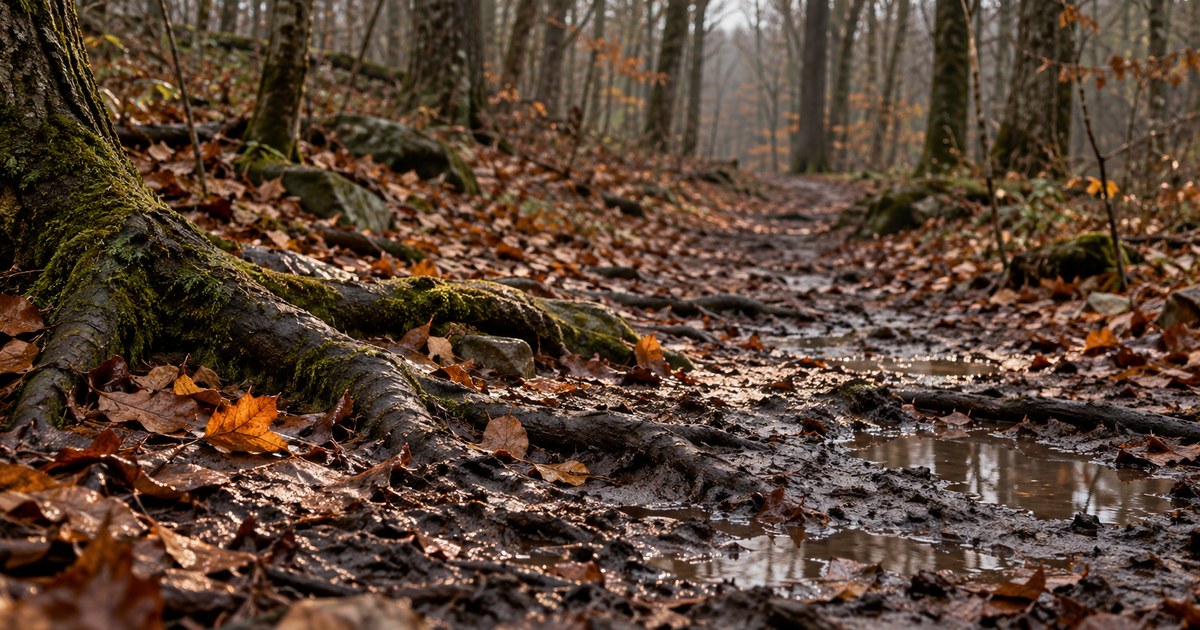
Coyotes leave their scat where it will be found. Washington describes droppings deposited in conspicuous places on or near the animal’s trails, and puts those trails along draws, fence lines, game and livestock trails, the middle of dirt roads and ridge tops. A twisted rope sitting in the open on a trail is a coyote until something disproves it.
Raccoons do the opposite and concentrate. The Centers for Disease Control and Prevention describes raccoons defecating at the base of or in raised forks of trees, and on raised horizontal surfaces such as logs and rocks, leaving dark tubular feces with a strong smell that often contain undigested seeds or other food items. A repeated pile in one of those places is a latrine, and the CDC publishes identification and cleanup guidance for raccoon latrines specifically. That is the source to use for anything beyond naming it, and it is the only place this article will send you for that.
Deer leave pellets where they bed and browse: field edges, brushy fence lines, orchard ground and backyard shrub beds. Otter leave theirs on rocks and logs at a shoreline, and Missouri notes the content that gives them away, fish scales and crawdad and shell parts.
What scat will not tell you
Not the species, most of the time. Washington’s own line about coyote droppings being extremely variable is the honest starting point, and a large domestic dog can leave something a guide would call coyote. Yosemite’s separation of cat scat from the rest is useful here: bobcats and mountain lions both leave segmented deposits that will not flatten underfoot, while a berry-season bear plop flattens readily. Age, health and last week’s meal move the appearance, and none of those are visible in the deposit.
It will not tell you how long ago the animal was there with any precision, and it will not tell you how many animals there were. What it does tell you, reliably, is what general kind of animal is using that ground and roughly what it has been eating, which is usually the actual question behind “what animal poop is this.”
Photograph it from directly above with a coin beside it, then take a second frame close enough to show whether the content is hair, seed or plant fiber. Do not turn it over or break it apart. Animal Identifier reads a photo of the animal itself, from the camera or your gallery, and returns a species with its Latin name, habitat, diet and behavior along with a match percentage, which is a confidence figure rather than a verdict. It does not read scat, tracks, skulls or feathers, so a photo of a deposit is a field note for you, not an input for the app. When the animal that left it walks out at dusk, that frame is the one worth taking. For bones and skulls found along the same trail, animal skull identification works through the tooth row first.
The field-sign guides cover each of these species in detail, what animal is this is the general walk-through for the animal itself, and reading a print in mud or snow is the other half of the same walk, since tracks and scat almost always turn up within sight of each other. If a large black bird is working the same ground, raven or crow is settled by the tail before the size.
Sources
- The Scat Detective, Missouri Department of Conservation, Missouri Conservationist September 2021
- Common White-tailed Deer Sign, Maryland Department of Natural Resources
- Living with Wildlife: Coyotes, Washington Department of Fish and Wildlife
- The Scoop on Bear Poop, National Park Service, Yosemite National Park
- Preventing Raccoon Roundworm, Centers for Disease Control and Prevention