
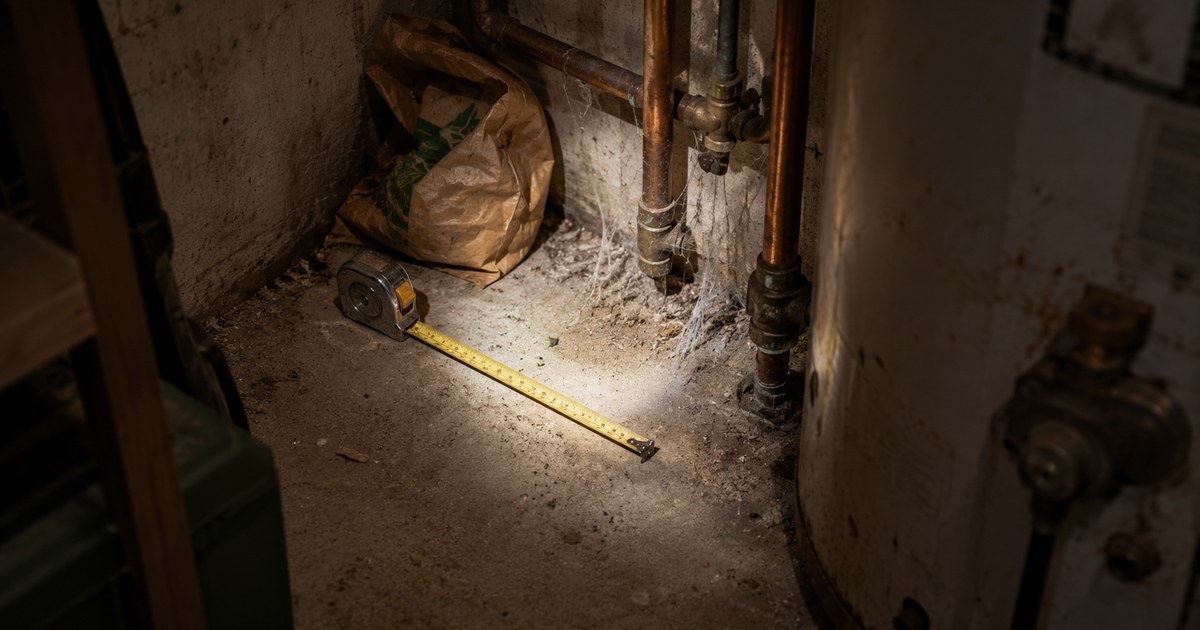
Measure one. A house mouse leaves a dropping about the size of a grain of rice, 1/8 to 1/4 inch (3 to 6 mm) long, slender and pointed at the ends. A Norway rat leaves one of 3/4 inch (19 mm) or more by most agency figures, thick and blunt at the ends. Nothing else separates the two as cleanly as length.
Mouse poop vs rat poop is settled by length and end shape. Cornell’s Integrated Pest Management program gives mouse droppings at 1/8 to 1/4 inch (3 to 6 mm) and Norway rat droppings at 3/4 to 1 inch (19 to 25 mm); Wildlife Illinois calls the mouse’s slender and pointed and the rat’s blunt-ended. Roof rat droppings, about 1/2 inch (13 mm), sit between.
How long is it?
Length first, because it is the figure every agency publishes and the one your eye gets wrong.
Cornell’s Integrated Pest Management program puts mouse droppings at 1/8 to 1/4 inch (3 to 6 mm) long, Norway rat droppings at 3/4 to 1 inch (19 to 25 mm), and roof rat droppings at about 1/2 inch (13 mm). Wildlife Illinois, the identification site run by the Illinois Department of Natural Resources with University of Illinois Extension, gives mice a slender, pointed dropping about 1/4 inch (6 mm) long and Norway rats a dropping of 1/2 to 3/4 inch (13 to 19 mm) with blunt ends. The University of Nebraska-Lincoln Extension’s rodent sign table lists house mouse feces at 1/8 to 1/4 inch (3 to 6 mm) and Norway rat feces at 3/4 inch (19 mm).
Notice that the Norway rat figure is not quite the same across the three. Illinois starts its range at 1/2 inch where Cornell and Nebraska start at 3/4 inch. That is normal for sign measurements, and the lesson is that a single dropping of 1/2 inch (13 mm) is in an overlap zone: it could be a small Norway rat dropping by Illinois’s figure or a roof rat dropping by Cornell’s. Measure several. A population of droppings that averages 1/4 inch is mouse, and one that averages 3/4 inch is rat, and the odd one in between does not change the verdict.
By Cornell’s and Nebraska’s figures a Norway rat dropping is three to four times the length of a mouse’s; by Illinois’s lower bound it is twice. Either way, a dropping that is merely a bit bigger than rice is still a mouse. Set a coin beside it in the photo and the scale takes care of itself.
What shape are the ends?
Pointed on a mouse, blunt on a Norway rat, and this is the second check rather than the first because it is the one that gets argued about.
Cornell describes rodent droppings generally as cylindrical, with pointed to rounded edges, which is a way of saying that shape runs on a spectrum. Wildlife Illinois is more specific: mice leave slender, pointed droppings, and Norway rats leave droppings with blunt ends. Put the two descriptions together and the rule reads as follows. A short dropping that tapers to points at both ends, like a tiny spindle, is mouse. A long dropping with rounded or squared ends, like a short section of thick cord, is Norway rat. Cornell’s half-inch roof rat dropping is the one that sits between them in size, and roof rats are a regional animal; Cornell notes they are generally not found in New York, and the Nebraska sheet says the state is currently outside their range.
Where did you find it?
Placement does nearly as much work as size, because the two animals use a building differently.
A house mouse lives close to its food. The UC Statewide IPM Program says house mice seldom venture more than 30 feet (9 m) from their nest sites and food supply, can squeeze under gaps 1/4 inch (6 mm) tall and through openings 3/8 inch (1 cm) wide, and build nests from finely shredded paper or other fibrous material in sheltered spots. Cornell adds that mice can nest inside walls, equipment and other protected places and can live their whole lives indoors. So mouse droppings turn up where the animal feeds and nests, along the back of a drawer, inside a pantry, behind a stove, within that short radius of wherever it lives.
A Norway rat lives in the ground or in a void and travels to its food. Cornell says Norway rats prefer to burrow in soil, will take advantage of voids near a food source, and need to drink standing water every day. Nebraska describes the den entrances as 2 to 3 inches (5 to 7.6 cm) in diameter with the ground worn smooth by use, and says feces, gnawing and tracks are found along the runways between the den and the food and water. Rat droppings therefore follow those routes: along a wall, behind a water heater, beside a floor drain, under a deck, at the base of a foundation, between where the animal sleeps and where it eats and drinks.
Two other kinds of sign agree with the droppings and are worth photographing at the same time. Gnaw marks come in two widths: Cornell gives an adult mouse’s paired tooth grooves as 1 to 2 mm wide and an adult rat’s as 3.5 to 4 mm, and Nebraska’s table puts the same figures at 1/12 inch (2 mm) for a mouse and 1/6 inch (4 mm) for a rat. And footprints, in dust or flour, come in two kinds: Cornell says mouse prints often look like a collection of dots, 3/8 to 3/4 inch (1 to 1.9 cm) long, while rat prints look like an actual foot, 3/4 to 1 1/4 inches (1.9 to 3.2 cm) long depending on whether it is the front or hind paw. If you want the general method for reading a print, the tracks identification post covers it, and sorting scat by shape, content and place is the companion for anything larger than a rodent.
What the droppings cannot tell you
Which mouse, for a start. Wildlife Illinois describes the deer mouse as having white undersides, white feet and a tail that is dark on top and white below, against the house mouse’s uniform gray-brown and a nearly hairless tail as long as or longer than its body. The droppings of the two are not separable by eye. Nor can a dropping tell you whether the animal is still in the building, how many there are, or where the entry point is; that is what the runway, the gnaw marks and the nest material are for.
It cannot tell you the animal’s size either, beyond mouse or rat. Wildlife Illinois gives the house mouse at about ½ ounce (14 g) and the Norway rat at 10 to 16 ounces (280 to 450 g). Those are adult weights; a juvenile rat can be far smaller, which is one more reason to measure several droppings in the overlap zone rather than one.
Animal Identifier does not read any of this. It works only from a photograph of the animal, taken with the live camera or picked from your gallery, and what comes back is a species with its Latin name, taxonomy, habitat, diet and behavior and a match percentage, a confidence figure rather than a verdict. A photo of a dropping will not come back with a name. If you catch the animal itself in a frame, on a counter at night or crossing the garage floor, that frame is what settles the question. The field-sign guides cover the tracks and scat of the larger animals outside, and what animal is this covers how to get a usable photo of an animal that will not hold still. For the small striped rodent on the deck rail rather than the one in the drawer, the squirrel or chipmunk post sorts that pair by the face.
Cleaning up, as the CDC states it
The CDC’s instruction is short and it is the one part of this subject where the steps come from a single published source rather than a judgment call. Do not vacuum or sweep rodent urine, droppings or nesting materials. Wear rubber or plastic gloves. Spray the urine and droppings with a bleach solution or an EPA-registered disinfectant until very wet and let it soak for 5 minutes, or for the time on the disinfectant label. Wipe it up with paper towels, put the towels in a covered garbage can that is emptied regularly, then mop or sponge the area with disinfectant. Wash your gloved hands with soap and water or a disinfectant before taking the gloves off, and wash your hands with soap and warm water afterward. The CDC’s bleach solution is 1.5 cups of household bleach in 1 gallon of water, or 1 part bleach to 9 parts water, mixed fresh before each use. For a home or outbuilding that has been closed up, the CDC says to open all doors and windows for 30 minutes before cleaning.
That is the whole list, and it applies to a mouse dropping and a rat dropping alike. Identify the animal with a ruler and a photograph of the sign, confirm it with a photograph of the animal if you get one, and leave the cleanup to the method above.
Sources
- Mouse and Rat Biology and Behavior, Cornell Integrated Pest Management
- Rats and Mice, Wildlife Illinois (Illinois Department of Natural Resources and University of Illinois Extension)
- Controlling Rats (G1737), University of Nebraska-Lincoln Extension
- How to Clean Up After Rodents, Centers for Disease Control and Prevention
- House Mouse, UC Statewide Integrated Pest Management Program